

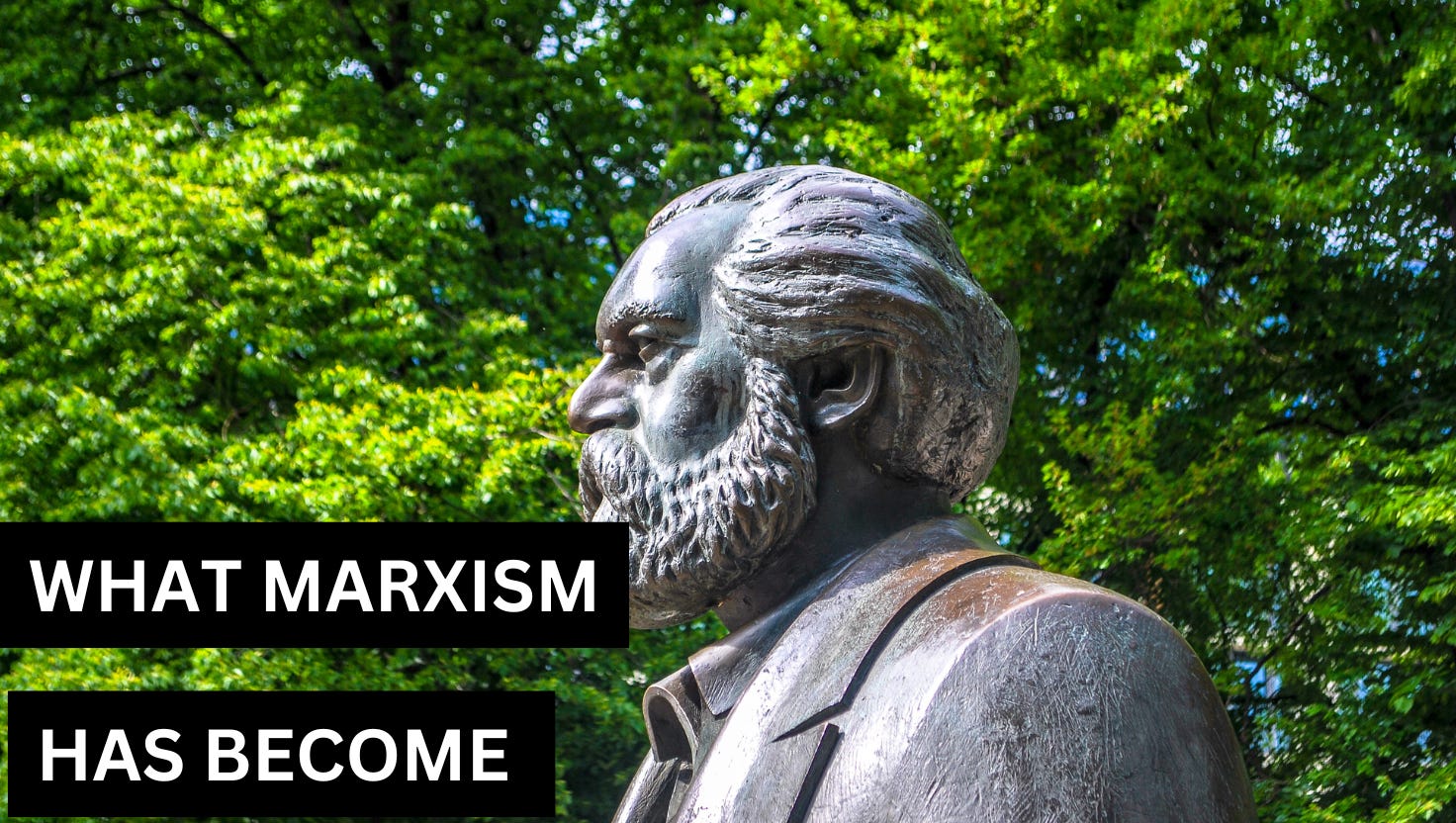
What Marxism Has Become
Instead of focusing on the emancipation of the working class from the excesses of capitalism, contemporary Marxism has devolved into an increasingly niche set of grievance studies — one that merely serves to undermine the working class solidarity it once claimed to champion.
So how did we get here?
Because Marxism was never rooted in actual human psychology to begin with.
Marx assumed that material conditions determined consciousness — that workers, once aware of their exploitation, would inevitably organize against it. They largely didn’t. And when they did, in the advanced economies Marx said were most suited for his program, the revolts didn’t last long. They were more like street festivals, after which everyone went home to their perfectly comfortable, capitalist-made beds.
Later attempts to patch this theoretical inadequacy by incorporating Freudian psychology via the Frankfurt School weren’t much of an improvement. Freud’s framework was itself hardly scientific — he never used statistical analysis, controlled studies, or any form of empirical measurement to corroborate his claims. Instead he borrowed much of his psychological theory directly from Schopenhauer, without credit, then used direct observation of patients to anecdotally confirm notions he already held.
Nor can today’s theorists do better. Scientific claims require observable conditions, and the conditions that grounded Marxism have largely ceased to exist.
The modern heirs of Marx have become, unlike Marx and Engels, almost entirely divorced from the lived realities of working people. Marx spent time in factories. He talked to workers. Today’s neo-Marxist academics publish in journals that working people will never read, about problems working people do not recognize as their own. The theory has become a credential, not a cause.
The labor constituencies Marx’s philosophy attempted to uplift — the industrial working class, the coal miners, the factory floor — have largely vanished from advanced economies. And even if remnants could be found, almost no one would care to look. In prosperous market societies, people increasingly and reasonably prefer the genuine pleasures of private life over collective political mobilization. This isn’t false consciousness. It’s a rational response to prosperity. When you have money, you want to do something with it — not carry signs about a utopia that’s never going to come.
The specter of Marxism has failed on its own terms. It promised liberation and produced academese. It promised solidarity and produced fragmentation. Whatever problems capitalism generates, Marxism has long since disqualified itself as the answer.
Zigmund Reichenbach has an M.A. in Philosophy from West Chester University and is a professional advocate for less government. You can help him combat bad ideas in politics and philosophy by donating to his work at https://ko-fi.com/zigmundreichenbach .
Follow him on X at @zreichenbach1!